
Introduction

Course Development

eLearning Artifact

Project Management
To answer the question, “What is my experience with online courses?” I want to highlight my course development process, and showcase an eLearning artifact that I helped an instructor add to her course.
Course Development
Process
I follow four of the five ADDIE steps when developing an online course, Analyze, design, develop, and implement. I am not involved with course evaluations as the courses I complete are reassigned to other instructional designers.
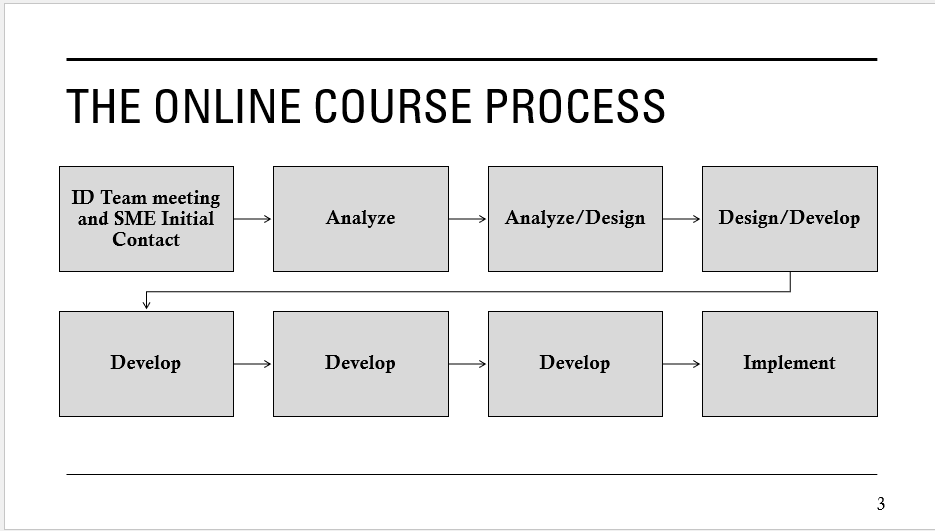
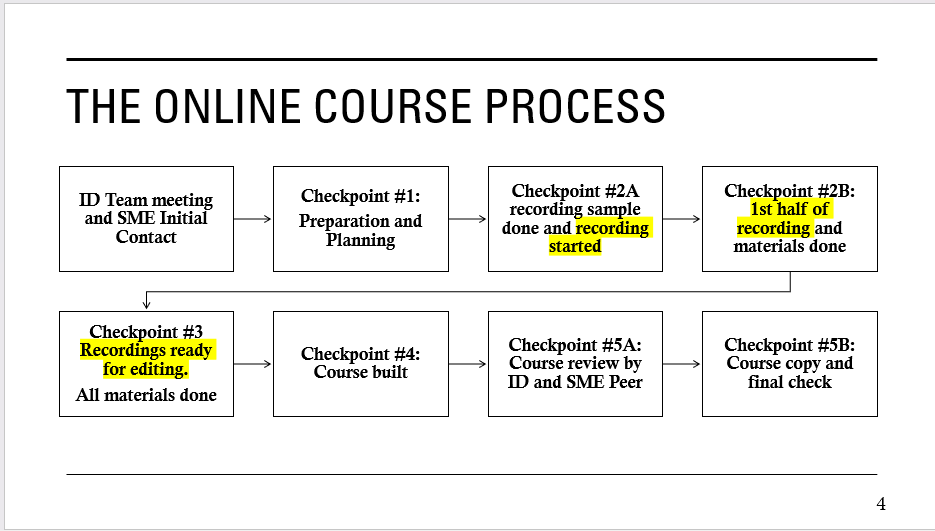
Because online course development takes seven months, I must complete analysis and design by the first month so instructor can complete all their lecture recordings by the third month for checkpoint 3. To ensure that instructors understand and approve the course setup, I utilize SAM.
eLearning Authoring with SAM
SAM, the abbreviation for Successive Approximation Model, helps me develop prototypes for grading, group projects, and course navigation.
| SAM | Analyze | Design | Develop |
| Cycle 1 – Test | How can an online course foster class collaboration? | Offer options for group assignments, discussion boards and other LMS tool options | Provide recommended eLearning setups for the instructor to review. |
| Cycle 2 – Refine | How can the instructor manage the online course? | Create a weekly module prototype and grade setup based on the instructor’s feedback and available course materials. | Replicate approved setup for each learning module. Create the grade setup to add group assignments to midterm and final grades. |
I also utilize SAM when I create eLearning tutorials for instructors and students.
eLearning Artifact
To ensure that students were prepared to create group video essays as a final project, a film studies instructor wanted the class to create a series of references together as one of three exercises in collaboration as film production is collaborative. I recommended Blackboard wikis because they allowed students to contribute and create one or more pages and allowed the instructor to track and grade each student’s contribution. Because it was unusual to expect an entire class of 50+ students to complete wikis together, I assisted the instructor with making instructions more apparent and providing a template for a consistent format.
To review the navigation, please play the video below.
This wiki setup, in addition to requiring student groups to post a production journal, and provide group to group feedback for the script and storyboards, helped students create group video essays that were uploaded into a discussion board that served as a mini film festival that awarded bonus points for the video with the most likes.
When I create training content, I first review the available documents to draft a handout for students or instructors. If there is a need for a video tutorial, then the handout serves as a storyboard and a start of a tutorial script.
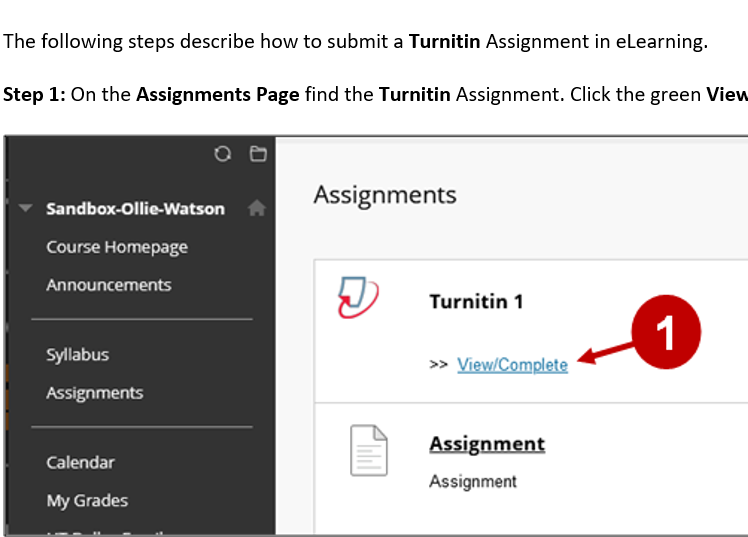
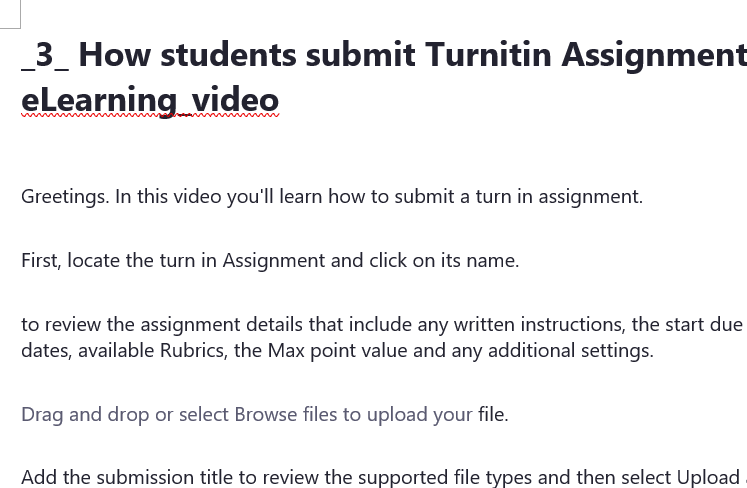

Once the handouts and videos are finalized, they appear on various eLearning webpages that are openly available online. Instructors and other campus departments can then decide to post these tutorial links on in their courses or eLearning organization setups.
Project Management
Although I am aware of management programs like Asana, my job utilizes Excel, Outlook, and Teams to track work and review progress. Currently I rely on one Excel spreadsheet for the following
- Training Records
- Course Design
- Training Content
- Student Worker Tasks
I developed and revised the Student Worker task sheet with feedback from student workers hired by the eLearning training manager so the students and I could review each other’s questions, feedback, and completion notes for completing training materials, and testing eLearning setups.
Conclusion
This is a small sample of the work I complete as an instructional designer and trainer. Assisting instructors with designing and managing online courses because of sudden internal and external challenges.
 Joo Eun Haldeman