
Introduction
Course Development
Project Management

eLearning Artifact
To answer the question, “What is my experience with online courses?” I want to share my course development process, and showcase an eLearning artifact for a Blackboard film studies course.
Course Development
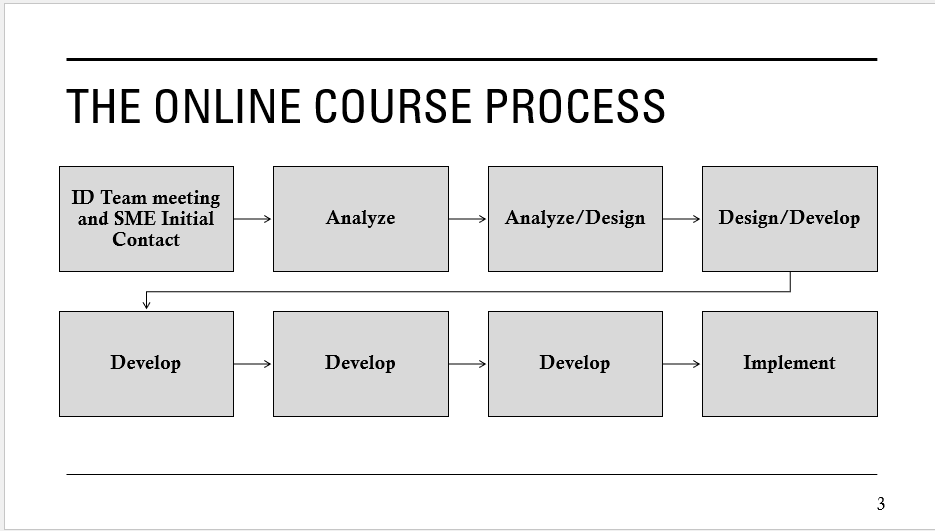
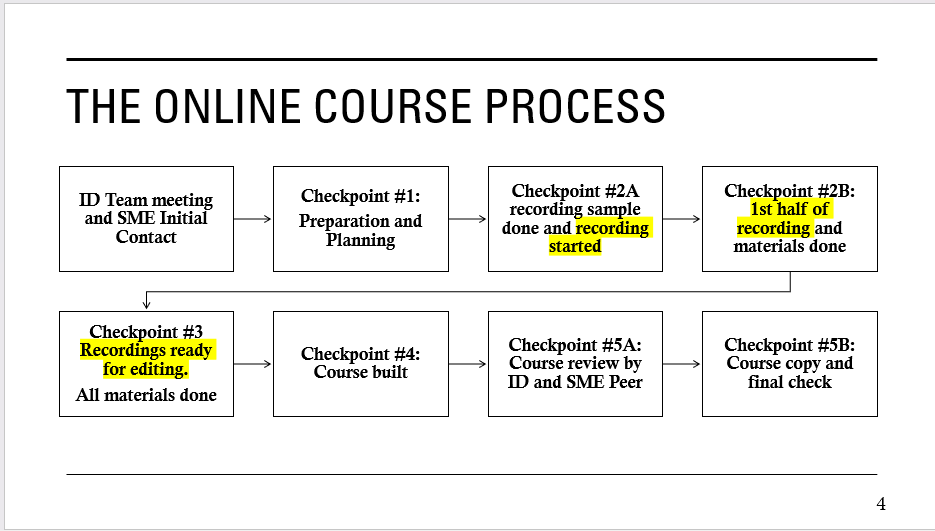
When working with an SME for online course development, I have seven months to follow four of the five ADDIE steps, analyze, design, develop, and implement. Because lecture recordings take the most time to create and edit, I use a production timeline with five checkpoints to ensure that an SME records lectures for the first three months so the recording studio has three months to complete edit and cleanup the lectures to ensure that the course is ready for review and upload in the last month.
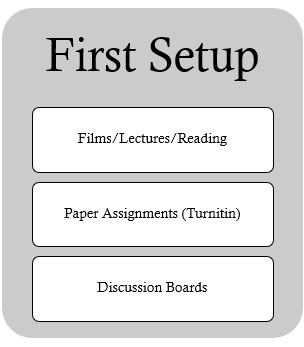
I worked on a film course that ended up with two course developments for one development cycle. Originally the first instructor and the department head wanted students review content and write papers to prepare for a final paper.
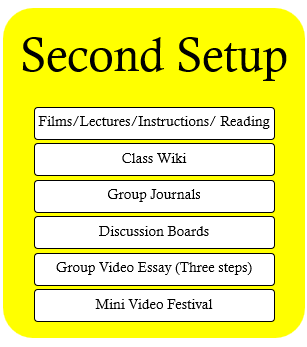
When the first instructor left two months later, the course was assigned to a second instructor who wanted to redesign the course that emphasized heavy engagement and collaboration. Instead of a final essay, the second instructor wanted the students to create group video essays for the final project. With only 70% of the original production time left several project management steps were taken.
Project Management
To ensure that the new film studies instructor had the desired setup, I utilized SAM.
SAM, the abbreviation for Successive Approximation Model, helped me develop prototypes for grading, group projects, and course navigation.
| SAM | Analyze | Design | Develop |
| Cycle 1 – Test | How can an online course foster class collaboration quickly? | Offered options for group assignments, discussion boards, journals, and wikis. | Created Blackboard wiki setups. Populated students entries with AI. to demonstrate wikis’ strengths and weaknesses. |
| Cycle 2 – Refine | How can the instructor manage the online course? | Created a weekly module prototype and grade setup based on the instructor’s feedback and available course materials. | Replicate approved setup for each learning module. Create the grade setup to add group assignments to midterm and final grades. |
Because the second setup favored active learning, hour long lectures were replaced by shorter film introductions and instructions for course group work to prepare for the final project, a group video essay. To celebrate the cumilation that the students would post in a discussion that served as a mini video festival to review and celebrate work.
eLearning Artifact
To prepare students to create group video essays as a final project, they had to learn how to collaborate. I recommended Blackboard wikis because they allowed students to contribute and create one or more pages and allowed the instructor to track and grade each student’s contribution. Because it was unusual to expect an entire class of 50+ students to complete wikis together, I assisted the instructor with making instructions more apparent and providing a template for a consistent format.
To learn more about Wikis, please watch the following video walkththrough.
Evaluation
The course received positive instructor, instructional design, and peer review before the semester started and mid semester. The instructor’s mid semester feedback for the course was positive because wikis had the desired effect. If the students had used AI for Wikis, then the requirement to edit a class document had minimized its impact. The peer review was so favorable that the film course was upgraded to department template status so other instructors could engage students with the same course design. Later that year, with the instructor’s permission, the course template was featured for the university’s National Distance Learning Week.
 Joo Eun Haldeman